
A tried and tested system that works!
If you are like me few years ago, you would be spending hours busy but end each day staring at an ever growing pile of tasks.
This can be disappointing and exhausting
Tired of this, I decided to learn a way around this. With a few tips and change in mindset, I managed to get ahead and take charge!
And now,
- Work pile up does not stress me at all.
- All work eventually gets done – professional & personal
- I feel satisfied at the end of day – well most days 😀
- I sleep very well!
I have written down tried and tested methods that helped me. hope it helps you too!
IF you are running short on time or attention, please skip right to the end for a bullet point summary 😀
First, the right mindset
- You are the master of your own to-do list. It is up to you to create something that is bound to make you feel amazing at the end of each day and set you up for definite success
- Everyone struggles with limited time and an ever – piling to-do list. Your boss, your mother, your house help.
- There is no place for guilt. No place for shyness. No place for remorse and embarrassment here. We are on our own growth path and everyone is welcome. There is no space for nay – Sayers.
- There is nothing to lose and everything to gain
Now, the framework
- Plan when you are feeling positive
Usually late afternoons, is when I have covered a good deal of work and I want to take a break. This is the time I create the task list for the next day.
In your case, the window may be evening over a coffee break. Its best not to plan a long list of tasks when you are really tired, like at night before you sleep or just before you leave office for the day.
When you are tired already, seeing a long list of tasks for the next day will make you feel lousy. You may go back home disappointed, you may not even be able to sleep well.
What’s the point of working so hard all day and not even managing a peaceful rest. - Get ahead – take charge
Despite your best efforts, all through the week work would pile up – bills that need to be paid. plumber needs to be called, office deliverables that I can’t even name – but they exist for all of us. By the end of the week, you feel exhausted just looking at the list.
Now, don’t let the list get on top of you. Change the equation. Look the work in the eye, take a deep breath and plan the hell out of it. - Important Vs Urgent
Urgent tasks, like a “crying baby,” demand immediate attention, but they aren’t always important. Important tasks truly move you forward. More often than not, we spend our time on urgent matters and feel unaccomplished by week’s end, because we neglected what’s crucial. Let’s understand the difference and identify these.
Here’s an interesting backstory:
This concept seems to have originally developed as Urgent and Important Matrix by Dwight D Eisenhower, the 34th President of the United States a time-management and prioritization tool that helped decide which actions to take first.
Stephen Covey refined this matrix to the now popular tool known as the ‘Eisenhower Matrix’
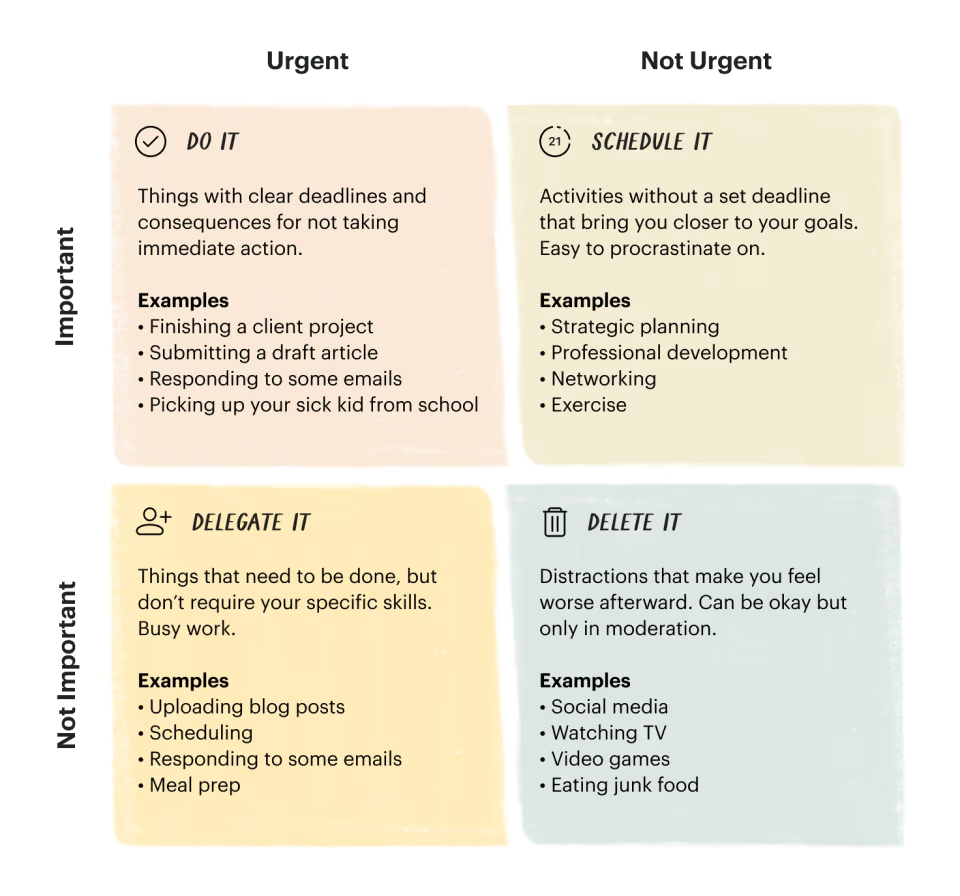
Source: www.todoist.com
I used to have two physical jars (more small plastic bottles) marked “Urgent” and “Important”. I kept a bunch of little cut up pieces of paper and a pen handy. Instead of adding to a mental list and creating stress for my brain, I would write down tasks that came to mind and put them in the Urgent or Important jars. When it was time for planning my week, I would take out these little notes and schedule them in as best as I could.
My daughter saw me do this regularly. When it was time to make something in her carpentry class, she decided to make something nice for me! 💖
Here it is

I am a proud Mumma 😀
Now let’s get down to it
Let’s do this together. As you read this, create that BIG LAUNDRY LIST of tasks. From tasks, research, phone calls, meetings, dress fittings to resume update, job applications, emails, nail spa, hair cut – everything.
In fact, I even mail out to my PM, bosses and family asking for them to plan work and assign me mine, along with priorities so I can ‘schedule my week’. This tells them they can’t shove unplanned work on my plate. It also sets the right boundaries.
Take a Friday or Saturday to put everything into a table with headings like this:
We will get it all done. Trust me.
I am adding some examples below…some from my list
| Work – Personal/Home | Work – Office/other | ||
| Important | Music school for kid | ||
| Vacation travel plan | |||
| Garage declutter | |||
| Read article on Gen AI | |||
| Enrol for certification in ABC course | |||
| Urgent | Insurance renewal | ||
| Respond to emails | |||
| Others | Phone call to friend A | ||
| Respond to social media messages |
Done?
Now, add one more title ‘Time’.
Don’t let this throw you off. Unless you are a developer submitting estimates to a client, you know a ball park would do. Don’t get too detailed, especially for personal work. 5 mins, 1/2 day, 5 days are all good.
| Work – Personal/Home | Work – Office/Other | Time | |
| Important | Music school for kid | 1/2 day | |
| Vacation travel plan | 1/2 day | ||
| Garage declutter | 1 day | ||
| Read article on Gen AI | 15 mins | ||
| Enrol for certification in ABC course | 1 hour | ||
| Urgent | Insurance renewal | 30 mins | |
| Respond to emails | 20 mins | ||
| Others | Phone call to friend A | 1 hour | |
Respond to social media messages | 15 mins | ||
The planner
You can finally get your planner out now. Here’s mine for your reference. Clue – I am a serial planner 😀
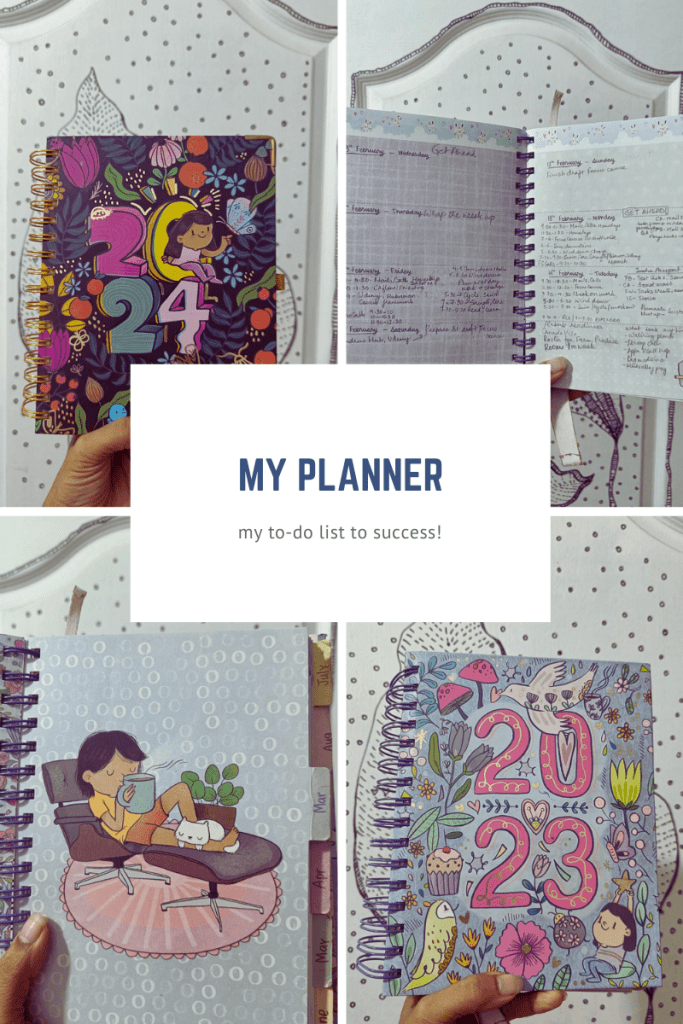
These planners bring sunshine and fun into each day..
Bought from: https://aliciasouza.com/
And now some key concepts:
Break it down to manageable tasks
If any professional task may take longer than 2 hours and personal task may take longer than 5 days, that’s probably because the task is actually a set of smaller tasks. So you need to break it down to smaller bits.
Here’s an example to understand this – let’s say you have to ‘Plan & book 2 week summer travel’
Here’s what it takes to accomplish this task
- Plan travel
- Create a list of destination options
- Read up on destination 1
- Read up on destination 2
- Read up on destination 3
- Plan places to see and do in all of these places and cost of everything, including travel. Compare and finalise destination.
- Book Travel
- Visa
- Speak to agent for visa
- Prepare documents for visa
- Submit documents
- Research on best flight routes and book tickets
- Visa
Now that you know what is the entire list of things that need to be done and how much time you would need to get each done, start putting into the planner. Not everything can or need to be done in a day. There will usually be some wriggle room.
Don’t overschedule
After the initial couple of weeks, your to-do list will start easing up. This is the time to ease up on the scheduling. As you start gaining control over your to-do list, plan for 50% – 60% of your active hours only. Trust me the 50% will stretch out into 100% of your work time.
For each day,
- Take 3 – 4 urgent tasks as required
- Take at least 1important tasks
- Take at least 3-5 5 – minute tasks
Don’t plan to multitask
High focus on one task gets it done fast. High focus means – hand, eyes and thoughts are all aligned to the one task at hand.
Learn to say ‘NO’
Find smart ways to say No or a version of it like, “Let me think about it”, “Let me schedule it in to my plan for the week”
Delegate what you can
See what work can be delegated, especially the urgent ones. This applies to professional and personal work.
5 minute tasks
Anything that can be done in 5 minutes or less should be done immediately.
Scheduling tips to follow
- Start the day with some calm time – meditate or read the paper or garden. some quiet time away from the phone getting some sun and setting yourself up for a peaceful, under – control day.
- Keep the mornings for work that needs deep thought and analysis. For my friends who are night owls, you can switch this over. Just make sure you get sleep 7 + hours of sleep.
- Keep afternoons for easier tasks that take less thought
- Evenings are for very easy tasks, emails, planning for the next day, auditing your work for the day etc and winding down.
- Once you start clearing the list of urgent things, you will gradually gain more control over your to – do list and time. This is the time to really put boundaries. No work on personal days off, no unscheduled work (this is called a Sprint bleed) unless urgent
- Use the weekend to build the life that you want. Meaning – read, workout, plan, study, fun and time with the family & friends.
- Keep some part of the day without a schedule, when you don’t need to look at the clock. Great if you can carve out this niche each day, but also ok if you just get this time off the clock during weekends.
SUMMARY!
| Scheduling helps get things done without unnecessary stress and anxiety |
| A practical to – do list ensures you feel productive and satisfied each day. So don’t overschedule. |
| A reasonable to – do list would have – – Up to 5 tasks that take less than 5 minutes – Up to 3 tasks that take 2 hours each – At least 1-2 tasks from the ‘important’ list – Not more than 70% tasks from the “Urgent” list initially – Not more than 50% tasks from “urgent” list as you progress This allows for spillages, unexpected small tasks, calls, breaks etc |
| Track a bleed. Keep an eye on the time planned for a task and take corrective action if you are going overboard. |
| Tasks that need deep thought are best done when you are calmer and the brain is alert. Tasks that need less thought can be scheduled for other times |
| Start your day with some peaceful tasks like yoga, coffee, paper, reflection etc |
Implement these changes and you will start seeing the difference very soon…
Less stress
More joy
More peace
Fun
Laughter
Happy bosses!
😀


 MY HAPPY TRYBE
Leave a reply to Outsidethebud Cancel reply